

Ageratina altissima | White snakeroot
White snakeroot occupies the herb layer of temperate deciduous woods and their edges. Its useful garden lesson is to reproduce the balance of filtered light, available moisture and soil air found in those settings.
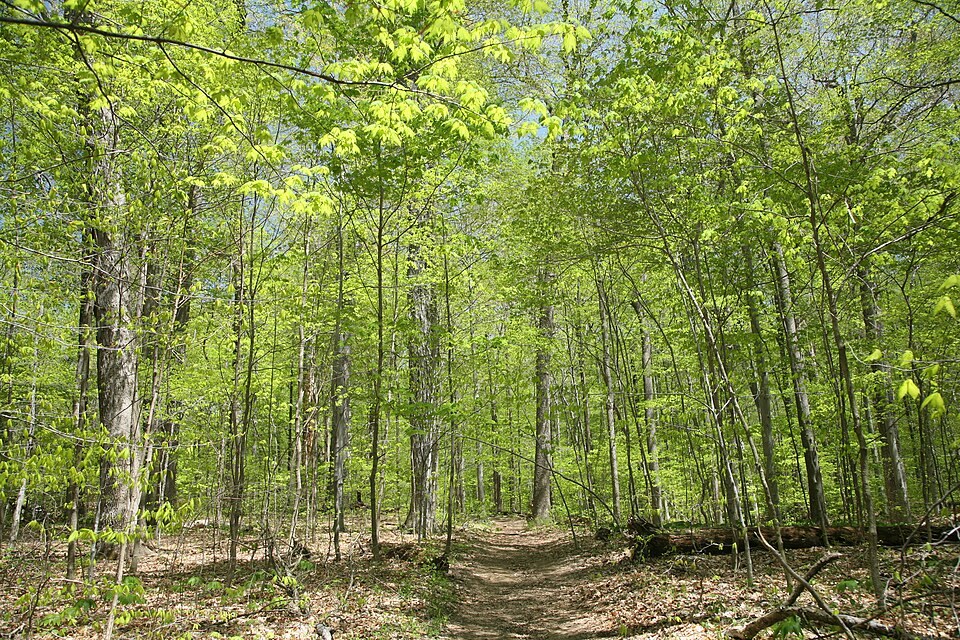
Photograph: Daniel Schwen · Original source · CC BY-SA 4.0. Resized proportionally.

Environment at a Glance
Feature | Typical condition |
|---|---|
Environment | Terrestrial woodland understory, edge or thicket. [IL] |
Geographic context | Eastern and central North America; Indiana lies within the species native range. [Kew] |
Water | Moist to somewhat dry, depending on shade and soil; avoid prolonged root saturation. [IL] |
Soils | Loam or clay loam with functioning drainage and a surface organic layer. [IL] |
Vegetation structure | Tree canopy, variable shrub layer, seasonal herbs, litter and decomposers. |
Local evidence | Historical and recent Tippecanoe County herbarium collections. [IND, IND2] |
Physical Setting and Water
Slope, soil depth and canopy position can matter as much as the regional rainfall total. Water runs off exposed slopes but can collect in depressions. Roots need both water and oxygen. A shaded bed that remains saturated after rain should not be treated as equivalent to a drained woodland slope.
Rain reaches the ground through canopy gaps, dripping leaves and flow down stems. Tree roots compete for part of that water. Shade can therefore feel cool while the soil remains dry. Check below the litter before deciding whether to irrigate.
Climate and Seasonal Light
Lafayette has a cold winter and a warm growing season with precipitation throughout the year. Leafless trees admit more spring light; summer foliage creates shade. These seasonal changes explain why one light reading cannot fully describe a woodland planting site. See the Climate sheet for measured local normals.
Soils and Nutrient Cycling
Fallen leaves become habitat and organic matter. Fungi, microbes and small soil animals break down litter, releasing nutrients over time. Avoid treating ordinary woodland soil as an empty medium that needs frequent fertilizer. Preserve structure and reduce compaction from feet and equipment.
Site condition | Practical implication |
|---|---|
Intact crumb structure | Water can enter while pores retain air; avoid working wet soil. |
Thin organic surface | Moderates the seedling environment; keep dense mulch off intentional surface sowings. |
Compacted or buried crown | Restore suitable planting depth and drainage rather than masking the problem with fertilizer. |
Container culture | Use the complete Native Forest Plants Standard Mix in the Plant sheet. Potting media and woodland mineral soils are not interchangeable. |
Photograph: Famartin · Original source · CC BY-SA 4.0. Resized proportionally.

Photograph: Cbaile19 · Original source · CC0. Resized proportionally.

Vegetation and Ecological Processes
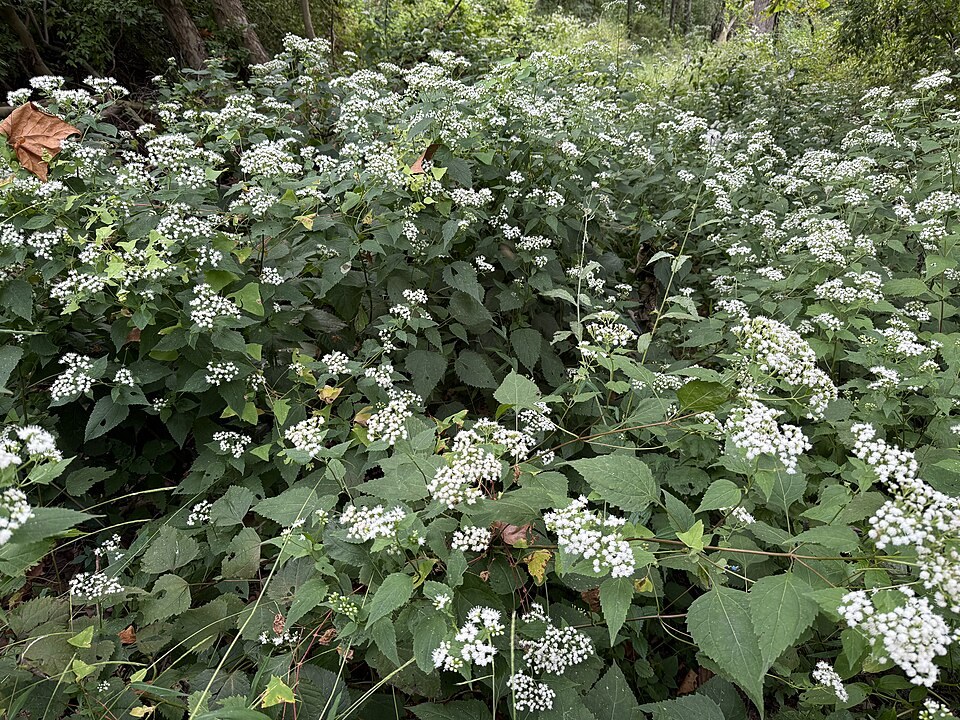
The forest supports layered competition. Trees intercept sunlight; shrubs and herbs share the remaining light, water and nutrients. White snakeroot can persist in shade and take advantage of openings. Seed arrival and rhizome expansion help it occupy disturbed patches. [PM]
It may occur in both disturbed woods and higher-quality habitat. Its presence alone is not a reliable score of woodland condition. Assess the full native plant community, invasive cover, soil disturbance and regeneration. [IL]
Disturbance and Management
Change | Likely concern | Useful response |
|---|---|---|
Canopy opening | Greater sun and drying; more open soil | Watch leaf stress and seedling recruitment. |
Soil excavation | Exposed seedbed and disrupted roots | Limit disturbance and re-establish diverse ground cover. |
Heavy rain | Pooling or erosion | Protect soil cover and assess drainage paths. |
Drought | Declining soil moisture | Prioritize young plants; water after checking the root zone. |
Grazing access | Poisoning risk | Exclude livestock and keep plant debris out of feed. [NC] |
Comparison with Lafayette
This is a local habitat type, not an exotic environment to recreate indoors. The county record near Romney describes white snakeroot as frequent with white oak in woods. Modern specimens add support for its continuing local occurrence. These records establish presence; they do not prove every shaded yard is suitable. [IND, IND2]
What to Observe
Record canopy shade, soil wetness after rain, afternoon wilting, colony boundaries and neighboring plants. Photograph the same patch through the seasons. In restoration work, favor a mixture of locally appropriate woodland plants and control known invasive species independently of white snakeroot.
Key Terms
Habitat is the place and conditions used by a species. An ecosystem includes organisms and their physical surroundings together. Microclimate means the local temperature, light, wind and moisture conditions. A rhizome is a spreading underground stem.
[Kew] Kew Plants of the World Online
[IL] Illinois Wildflowers species account
[PM] Species cultivation and spread account
[IND] Indiana University specimen IND 0120581 via GBIF
[IND2] Indiana University specimen IND 0162325 via GBIF
[NC] NC State Extension species profile
Deciduous woodland at Turkey Run State Park — Daniel Schwen. CC BY-SA 4.0
White snakeroot colony at Ann M Banchoff Park — Famartin. CC BY-SA 4.0
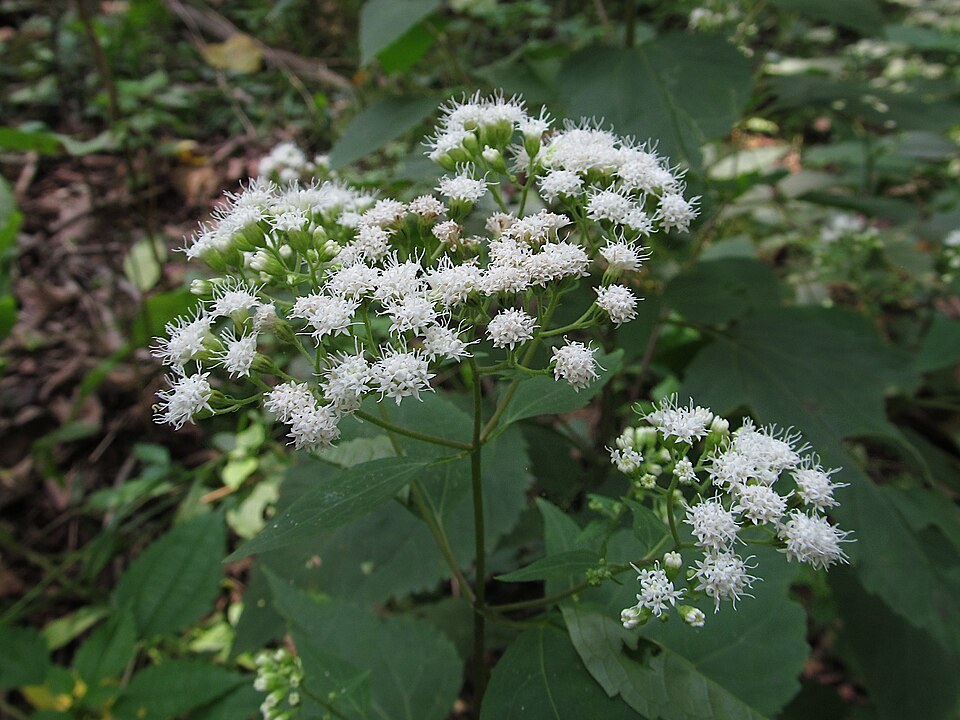
White snakeroot in Seldom Seen Greenway — Cbaile19. CC0
Related Information Sheets
Plant care and seed propagation