

Ageratina altissima | White snakeroot
White snakeroot links autumn flowers, wind-dispersed seed and woodland colonization. It can support insects while posing a serious ingestion hazard to mammals. Its value depends on the site, the surrounding plant community and access by grazing animals.
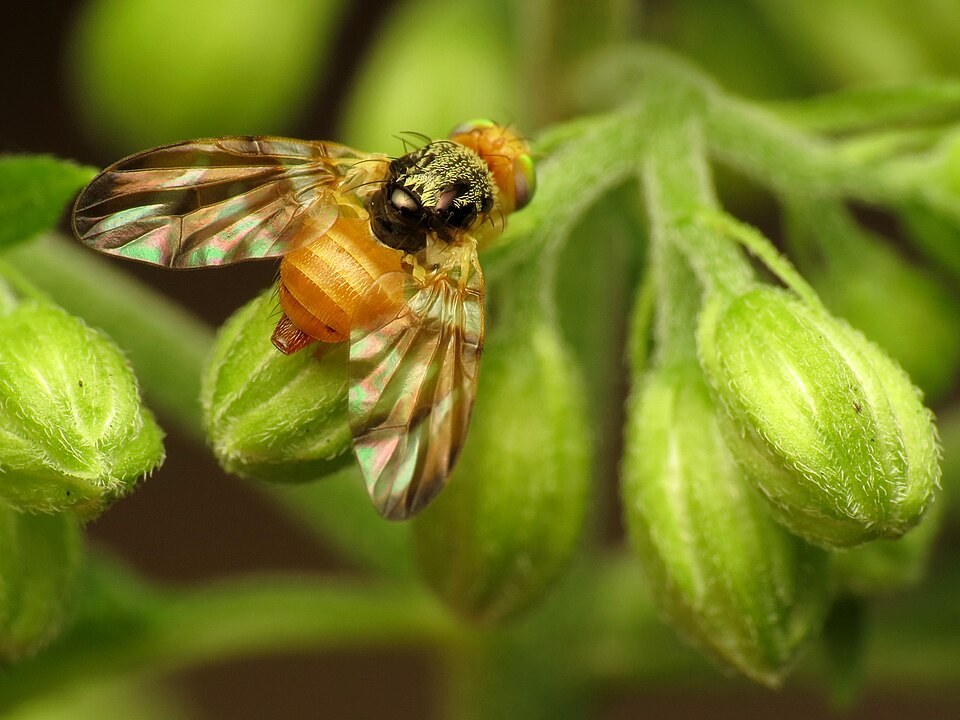
Photograph: Katja Schulz from Washington, D. C., USA · Original source · CC BY 2.0. Resized proportionally.

Ecological Role at a Glance
Relationship | Meaning |
|---|---|
Flower visitors | Bees, flies, wasps, butterflies and moths use the flowers; visits alone do not measure pollination success. [IL] |
Seasonal resource | Late flowers add forage when some earlier species have finished blooming. [BBG] |
Leaf consumers | Leaf miners and other insects can use tissues avoided by many mammals. [BBG] |
Dispersal | Hair-tufted fruits move in wind; rhizomes expand a patch locally. [PM] |
Mammals | Bitter toxic vegetation is often avoided, but ingestion can still occur. [IL, NC] |
Garden spread | An abundant native colony can still crowd a small planting. [PM] |
Flowers and the Food Web
Clusters of many small florets provide numerous feeding positions. Watch which insects visit and how they move between flower heads. Avoid equating the number of visits with the amount of seed set: effective pollination also depends on pollen transfer, compatible plants and weather.
Brooklyn Botanic Garden documents a leaf-mining fly using white snakeroot leaves. The larvae live within leaf tissue, leaving visible trails. Limited leaf damage can represent an ecological interaction rather than a plant-health emergency. [BBG]
The fruit-fly photograph records an insect on this plant; it does not by itself establish an entire host life cycle or prove pollination. Specific host claims require species-level evidence.
Seed Rhizomes and Recruitment
Wind can move seeds beyond the parent colony. Rhizomes, which are stems rather than roots, produce shoots near an established crown. That distinction matters in management: removing seed heads reduces seed dispersal but does not stop existing rhizomes from expanding. [PM]
Small seeds need a suitable landing place, moisture and seasonal cues. The practical protocol is moist winter chilling followed by uncovered surface sowing. A bare disturbed patch may favor recruitment, but the eventual result also depends on competing plants and weather. [Seed]
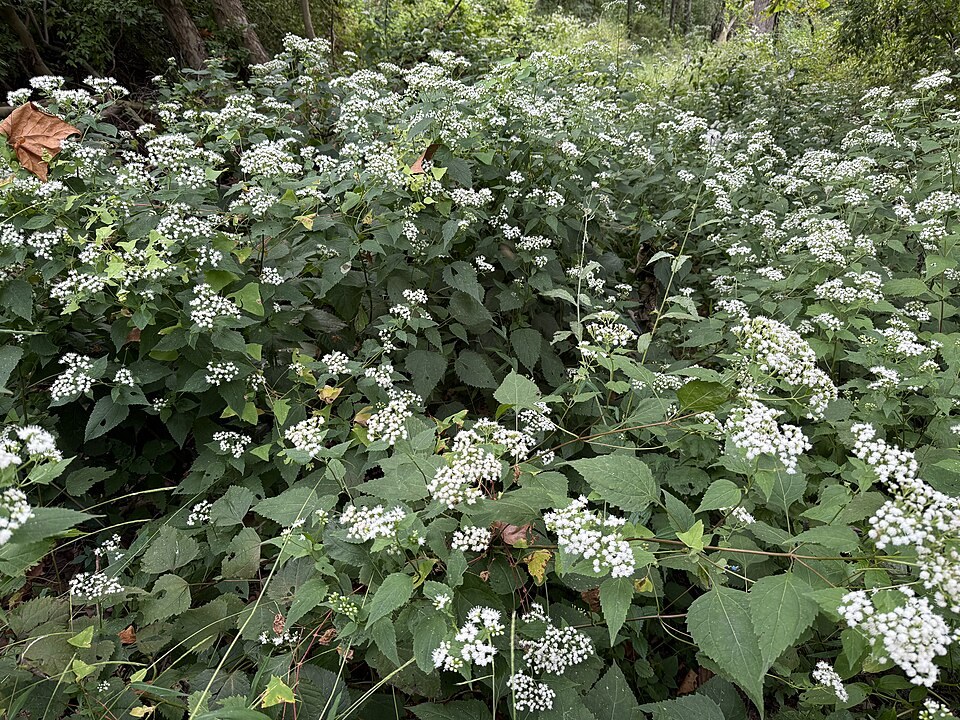
Photograph: Famartin · Original source · CC BY-SA 4.0. Resized proportionally.

Native Status and Aggressive Spread
Indiana nativity and Tippecanoe County herbarium records support a local-native designation. Kew also records introductions in parts of Europe and Korea. A plant’s status must be tied to geography; native in Indiana does not mean native everywhere. [Kew, IND]
White snakeroot is not listed in the Indiana DNR terrestrial invasive plant rule list reviewed on 2026-09-21. It may nevertheless become too abundant for a small garden. Distinguish unwanted local growth from an introduced invasive species. [DNR, PM]
Toxicity in an Ecological Setting
Plant chemical defenses can discourage some consumers without excluding all insects. White snakeroot is highly poisonous if ingested, and toxins can pass through milk from exposed livestock to people. Native status and insect use do not make it edible. [NC]
In pasture or animal-access areas, prevent grazing and remove the opportunity for exposure. In a managed woodland garden, assess whether children or pets chew plants. Keep pulled material and clippings out of feed and away from animals. Do not rely on a bitter taste as protection.
Managing a Diverse Woodland Planting
Maintain several native species with different flowering periods. Keep enough white snakeroot for the space and the management goal; thin excess seedlings and rooted shoots before they overwhelm neighbors. Avoid unnecessary spraying on flowers or lightly damaged leaves.
After invasive-shrub removal, monitor the whole recovering plant community. A flush of white snakeroot is not proof that restoration has succeeded or failed. Track native richness, bare soil, reinvasion and the persistence of other woodland herbs.
A Simple Observation Record
Record | Reason |
|---|---|
First flower and last flower | Tracks seasonal food availability and year-to-year change. |
Visitors during a timed watch | Allows comparison among dates; record weather and observation length. |
Colony outline and seedlings | Separates established spread from new recruitment. |
Leaf damage and nearby species | Connects herbivory, plant vigor and community diversity. |
Animal access | Keeps the ingestion risk visible in site management. |
Key Terms
Phenology is the timing of seasonal events. Recruitment is the arrival and establishment of new individuals. Herbivory is feeding on plant tissues. A pollinator transfers pollen; a flower visitor may or may not do so effectively.
[IL] Illinois Wildflowers species account
[BBG] Brooklyn Botanic Garden ecology account
[PM] Species cultivation and spread account
[Seed] Wild Seed Project species and sowing protocol
[Kew] Kew Plants of the World Online
[IND] Indiana University specimen IND 0120581 via GBIF
[DNR] Indiana DNR terrestrial invasive plant list
[NC] NC State Extension species profile
Snakeroot fruit fly at Rock Creek Park — Katja Schulz from Washington, D. C., USA. CC BY 2.0
White snakeroot colony at Ann M Banchoff Park — Famartin. CC BY-SA 4.0