

Solenopsis molesta
Follow this ant’s feeding, nesting, and relationships with plants and other animals to understand its role in the local community.
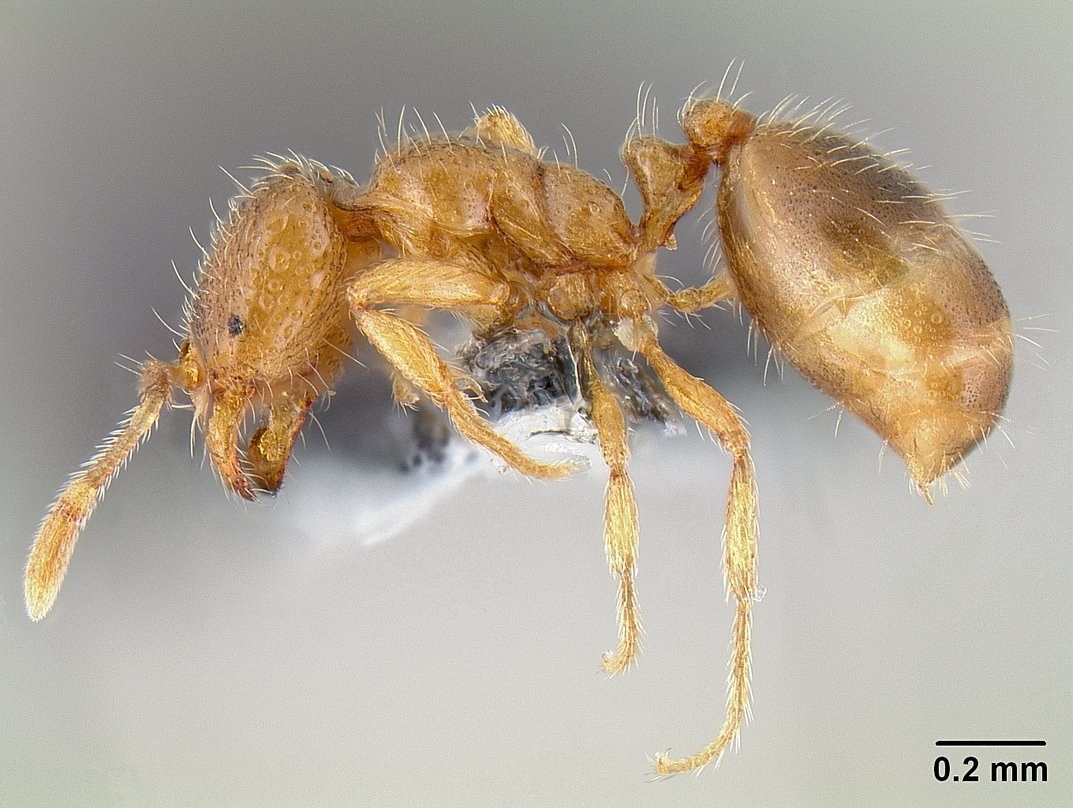
Photograph: Michael Branstetter · Original source · CC BY 4.0. Resized proportionally.

Food web role
Their small size allows them to exploit the margins of larger ant colonies and take brood or food. This is an interspecific interaction within the soil community, not evidence that the entire ant community is harmful. [Thief]
Relationships with plants
Thief ants are best understood as small predators, scavengers, and food thieves. Their presence around a plant does not establish herbivory or beneficial seed dispersal.
When ants visit a plant, distinguish feeding on plant tissue, gathering nectar or honeydew, hunting, and simple passage. Seeing ants on a flower does not establish effective pollination. [UC]
Colony and community
Colonies may have several queens. Workers tend eggs, larvae, and pupae in small concealed chambers. New colonies can begin after reproductive flights; the presence of one tiny worker does not locate the colony.
Tiny native ant; can contaminate stored food indoors. Morris lists Tippecanoe County for Solenopsis molesta. The record is historical and does not identify a present-day household infestation. [IN]
A question to investigate
Are workers collecting spilled food, carrying another insect, or entering a neighboring ant nest?
Observe for five minutes on at least three occasions. Record what workers carry or contact, note the weather, and include a nearby comparison area. Visible traffic is not a measure of total colony size.
Management implication
Remove contaminated food, clean grease residues, and store food in well-sealed rigid containers. Confirm thief ant versus pharaoh ant before treatment. Persistent infestations often need professional identification and follow-up.
Retain the observation record after any action. Compare the original problem, plant condition, and ant traffic rather than using the disappearance of every ant as the goal. [UC]
Useful terms
Honeydew is sugary excretion from sap-feeding insects. Brood means eggs, larvae, and pupae. A mutualism benefits both partners.