

Tetramorium immigrans
Follow this ant’s feeding, nesting, and relationships with plants and other animals to understand its role in the local community.
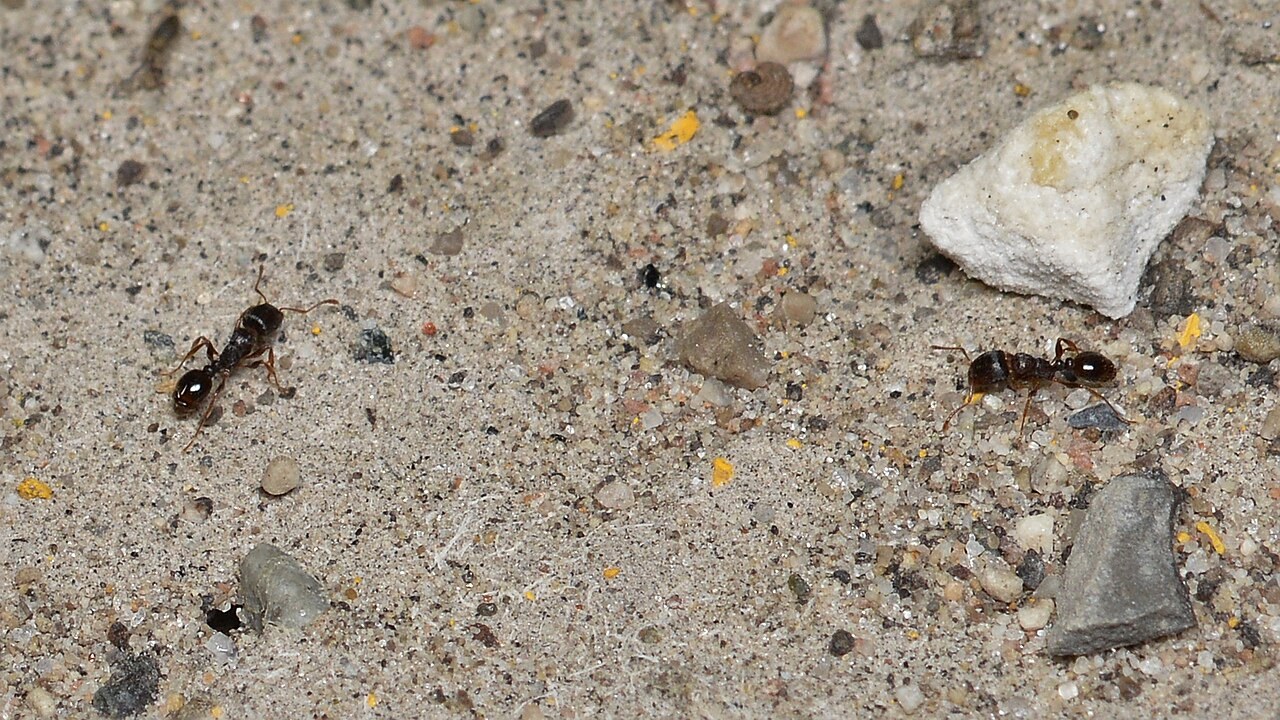
Photograph: Ryan Hodnett · Original source · CC BY-SA 4.0. Resized proportionally.

Food web role
This introduced species is particularly successful in cities. The 2022 review describes substantial knowledge gaps and generally modest documented impacts compared with several more damaging invasive ants. Introduced status and a measured local impact are different findings. [Pavement]
Relationships with plants
The main garden issue is usually location, not direct feeding damage to living plants. An ant carrying a seed may be moving, consuming, or discarding it; watch the outcome before calling the event seed dispersal.
When ants visit a plant, distinguish feeding on plant tissue, gathering nectar or honeydew, hunting, and simple passage. Seeing ants on a flower does not establish effective pollination. [UC]
Colony and community
A mated queen usually founds a colony independently. Mature colonies normally have one reproductive queen. Workers rear eggs, larvae, and pupae in underground chambers. Rival neighboring colonies may engage in conspicuous contests.
Widespread introduced urban ant; local ecological effects vary. Morris records the older pavement-ant name Tetramorium caespitum in Wayne County. That historical record alone is not a verified modern Tippecanoe record of T. immigrans. [IN]
A question to investigate
How do trail traffic and the number of active entrances differ between sunny and shaded pavement edges?
Observe for five minutes on at least three occasions. Record what workers carry or contact, note the weather, and include a nearby comparison area. Visible traffic is not a measure of total colony size.
Management implication
Tolerate outdoor colonies when they are not causing a practical problem. Indoors, remove food residues and seal entry routes. If needed, choose a labeled bait and follow progress over time rather than judging success by dead workers alone.
Retain the observation record after any action. Compare the original problem, plant condition, and ant traffic rather than using the disappearance of every ant as the goal. [UC]
Useful terms
Honeydew is sugary excretion from sap-feeding insects. Brood means eggs, larvae, and pupae. A mutualism benefits both partners.