

Lasius americanus
Follow this ant’s feeding, nesting, and relationships with plants and other animals to understand its role in the local community.
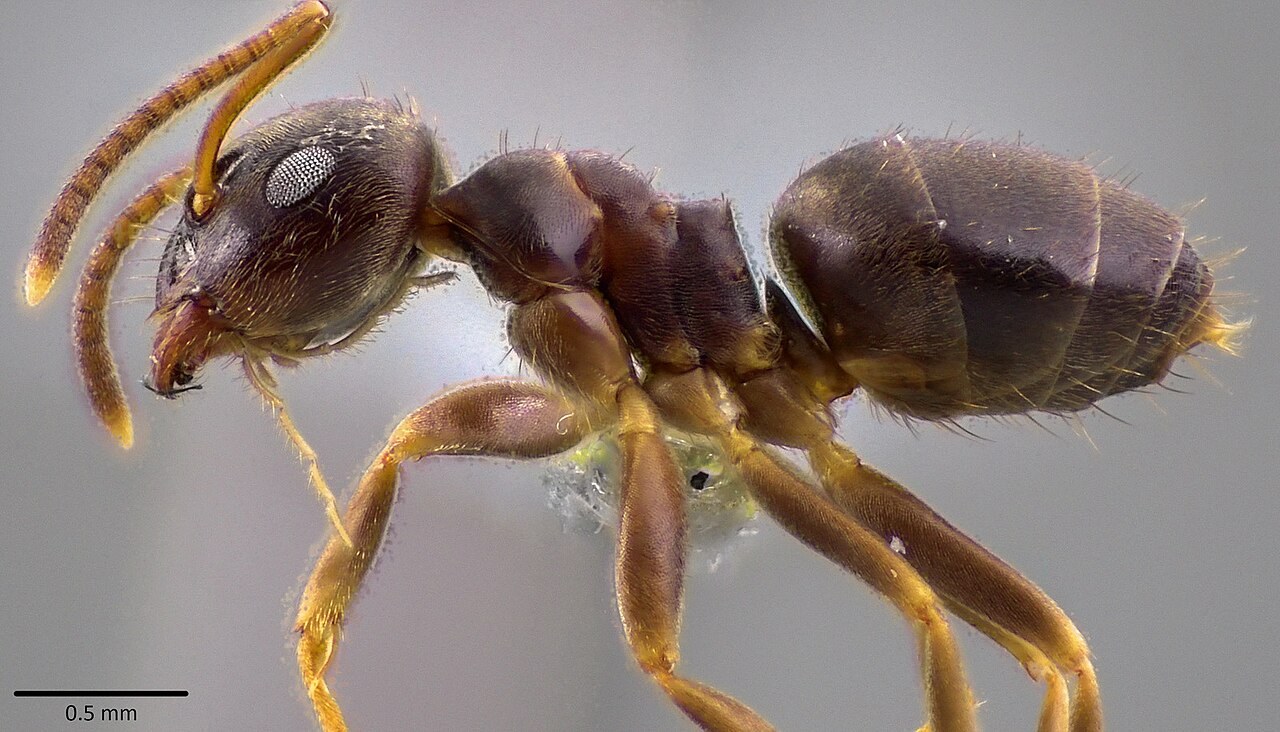
Photograph: Emmett Collins-Sussman · Original source · CC BY 4.0. Resized proportionally.

Food web role
This ant belongs to a larger community of small soil and woodland ants. Nest excavation and food transport connect belowground shelters with aboveground resources. Its ecological role cannot be inferred from the word cornfield alone. [ID]
Relationships with plants
Honeydew connects the ants with sap-feeding insects. Watch whether workers contact aphids, carry insect prey, or merely pass over a leaf; those observations imply different ecological roles.
When ants visit a plant, distinguish feeding on plant tissue, gathering nectar or honeydew, hunting, and simple passage. Seeing ants on a flower does not establish effective pollination. [UC]
Colony and community
Colonies develop through egg, larval, pupal, and adult stages. Winged males and young queens disperse seasonally. The size and behavior of a queen should not be compared directly with the worker identification characters.
Native soil and woodland ant; usually a minor nuisance. Historical Indiana Lasius records use older names with changing species boundaries. A current specimen identification is needed before assigning a historical locality confidently to L. americanus. [IN]
A question to investigate
Are verified Lasius americanus records more frequent beneath woody cover than in adjacent open turf on the same observation route?
Observe for five minutes on at least three occasions. Record what workers carry or contact, note the weather, and include a nearby comparison area. Visible traffic is not a measure of total colony size.
Management implication
Usually tolerate outdoor nests. For occasional indoor foragers, correct food and water attractions and seal access. Obtain a close identification before deciding that a recurring problem is this species.
Retain the observation record after any action. Compare the original problem, plant condition, and ant traffic rather than using the disappearance of every ant as the goal. [UC]
Useful terms
Honeydew is sugary excretion from sap-feeding insects. Brood means eggs, larvae, and pupae. A mutualism benefits both partners.