
Camponotus pennsylvanicus
Follow this ant’s feeding, nesting, and relationships with plants and other animals to understand its role in the local community.
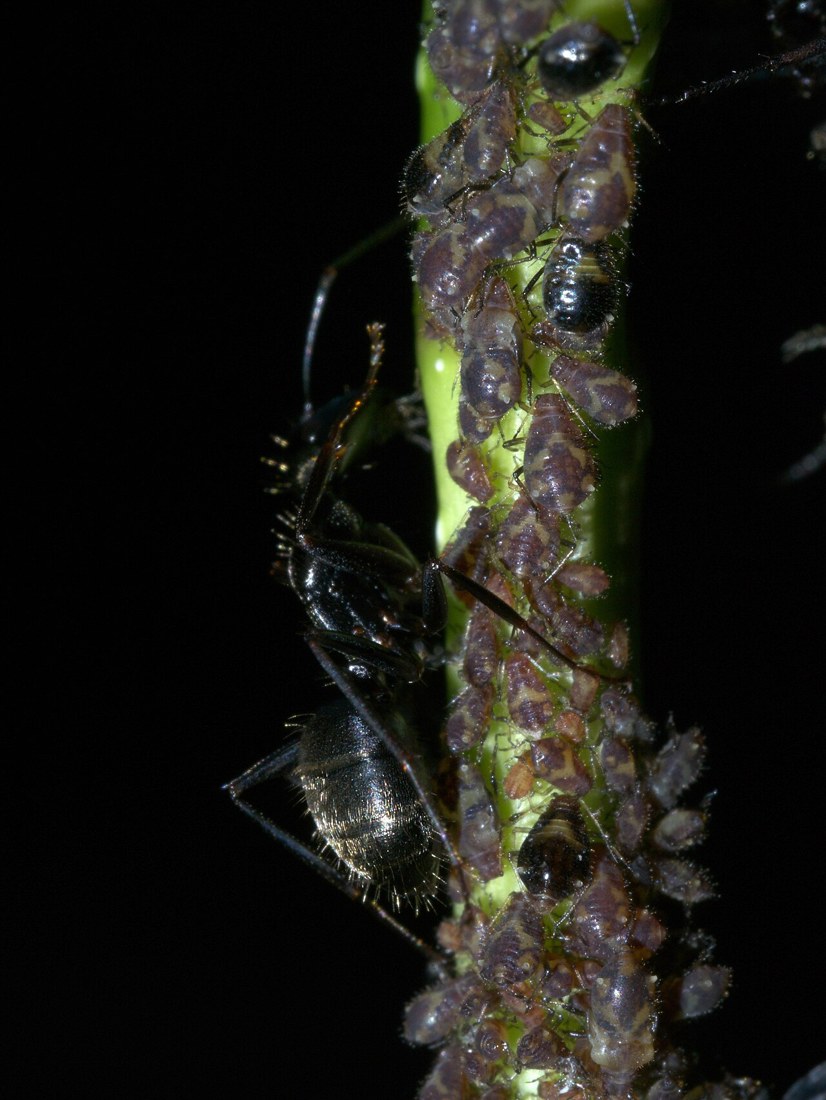
Photograph: xpda · Original source · CC BY-SA 4.0. Resized proportionally.

Food web role
Carpenter ants contribute to woodland food webs as predators and scavengers and as food for other animals. Their galleries modify dead or softened wood, but they do not digest cellulose in the way wood-feeding termites do. [Carpenter]
Relationships with plants
Workers on trunks may be hunting insects or collecting honeydew. Their presence on a living tree is not proof that the tree is dying; nesting in damaged wood and foraging on foliage are different observations.
When ants visit a plant, distinguish feeding on plant tissue, gathering nectar or honeydew, hunting, and simple passage. Seeing ants on a flower does not establish effective pollination. [UC]
Colony and community
Colonies include differently sized female workers, a queen, brood, and seasonal winged reproductives. A colony may use a main nest and additional satellite nests. Their moisture conditions and occupants can differ.
Native woodland ant; established nests can damage building wood. Morris lists Tippecanoe County under an older Camponotus pennsylvanicus combination. The record supports historical local occurrence, not a current nest location. [IN]
A question to investigate
Are workers merely crossing the trunk, collecting food on foliage, or entering a specific cavity?
Observe for five minutes on at least three occasions. Record what workers carry or contact, note the weather, and include a nearby comparison area. Visible traffic is not a measure of total colony size.
Management implication
Document activity and wood debris, repair water problems, and seek professional assessment when a building nest is suspected. Treating visible foragers alone can leave the main nest and satellites intact.
Retain the observation record after any action. Compare the original problem, plant condition, and ant traffic rather than using the disappearance of every ant as the goal. [UC]
Useful terms
Honeydew is sugary excretion from sap-feeding insects. Brood means eggs, larvae, and pupae. A mutualism benefits both partners.