

Crematogaster species
Follow this ant’s feeding, nesting, and relationships with plants and other animals to understand its role in the local community.
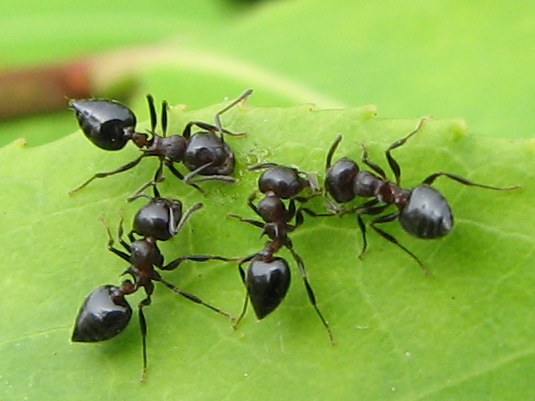
Photograph: Jacy Lucier · Original source · CC BY-SA 4.0. Resized proportionally.

Food web role
Acrobat ants can connect canopy resources with the ground and woody cavities. Predation, scavenging, and collection of sugary liquids each contribute to their food supply. The balance varies with species and site. [ID]
Relationships with plants
Workers often visit honeydew-producing insects. Directly observe the interaction before saying that the ants protect a pest. Nesting in a dead branch does not establish that the ants killed the branch.
When ants visit a plant, distinguish feeding on plant tissue, gathering nectar or honeydew, hunting, and simple passage. Seeing ants on a flower does not establish effective pollination. [UC]
Colony and community
Colonies contain workers, brood, and reproductive ants. Winged males and queens appear seasonally. Colony-founding biology differs among species, so a single nest size or reproductive schedule should not be applied to the entire group.
A genus group, not one species. Morris lists Tippecanoe County for Crematogaster lineolata and the historical cerasi form. These support historical group occurrence; the photos are not local voucher specimens. [IN]
A question to investigate
Do workers arriving at a branch collect honeydew, carry prey, or enter a woody cavity?
Observe for five minutes on at least three occasions. Record what workers carry or contact, note the weather, and include a nearby comparison area. Visible traffic is not a measure of total colony size.
Management implication
Preserve harmless outdoor colonies. Indoors, identify the nest location and correct damaged or damp wood. Persistent activity in inaccessible framing may require a pest professional.
Retain the observation record after any action. Compare the original problem, plant condition, and ant traffic rather than using the disappearance of every ant as the goal. [UC]
Useful terms
Honeydew is sugary excretion from sap-feeding insects. Brood means eggs, larvae, and pupae. A mutualism benefits both partners.