

Tapinoma sessile
Follow this ant’s feeding, nesting, and relationships with plants and other animals to understand its role in the local community.
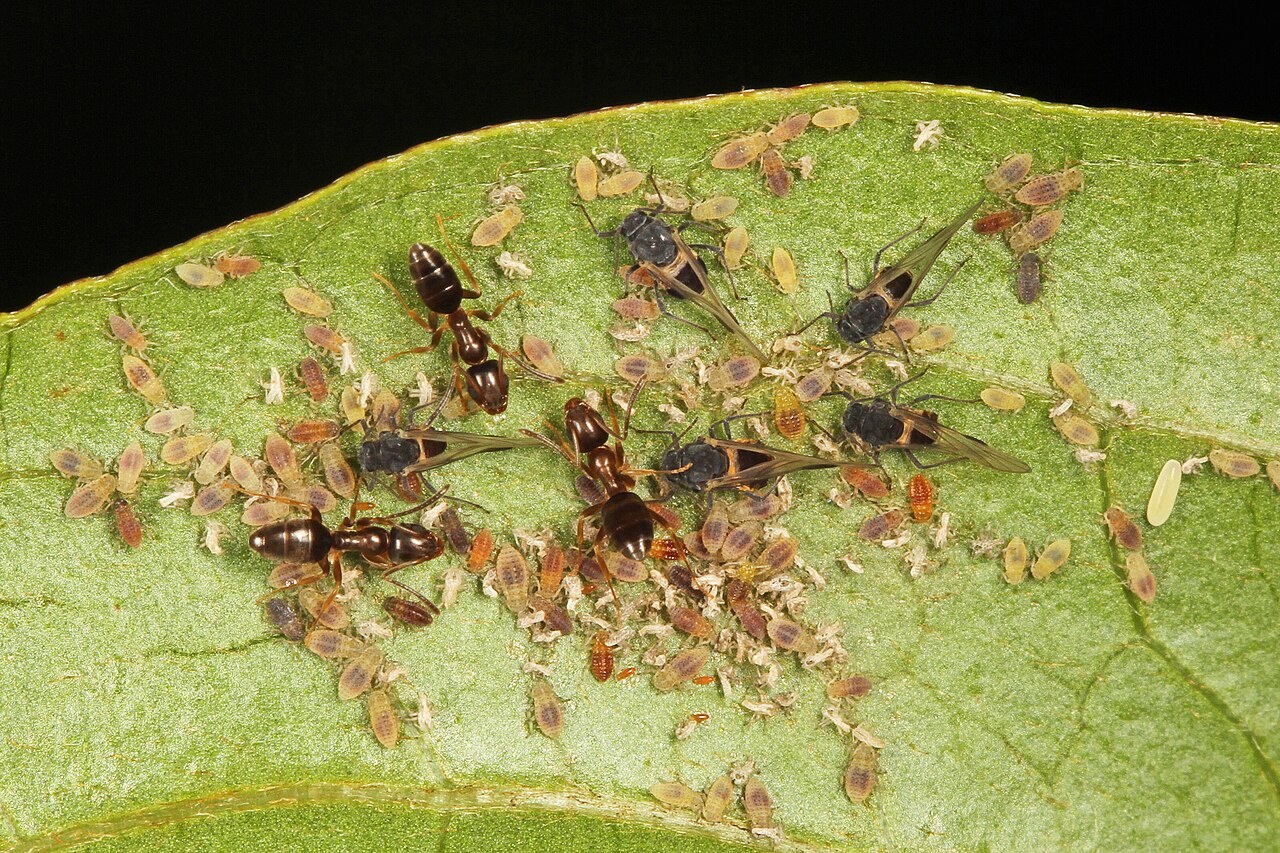
Photograph: Judy Gallagher · Original source · CC BY 2.0. Resized proportionally.

Food web role
This species links sugary plant-derived resources, other insects, and predators of ants. Foraging ants redistribute food within the colony, while their activity changes where small food remains accumulate. [ID]
Relationships with plants
Workers taking honeydew may defend sap-feeding insects. Their presence on a leaf is a reason to inspect the plant; it does not establish that the ants caused leaf injury.
When ants visit a plant, distinguish feeding on plant tissue, gathering nectar or honeydew, hunting, and simple passage. Seeing ants on a flower does not establish effective pollination. [UC]
Colony and community
Eggs develop through legless larvae and pupae into adults. Wingless female workers forage and care for the brood. Queens reproduce; winged males and young queens can appear during the warm season.
Native ant that can become a persistent household nuisance. Morris lists Tippecanoe County for Tapinoma sessile. This is a historical occurrence, not a current abundance estimate. [IN]
A question to investigate
Do trail counts increase on plants with visible aphids compared with nearby plants without them?
Observe for five minutes on at least three occasions. Record what workers carry or contact, note the weather, and include a nearby comparison area. Visible traffic is not a measure of total colony size.
Management implication
Clean up spills, seal food, correct leaks, and close entry gaps. For persistent indoor colonies, use a labeled ant bait appropriate to the site or obtain professional help. Keep sprays away from an active baiting program.
Retain the observation record after any action. Compare the original problem, plant condition, and ant traffic rather than using the disappearance of every ant as the goal. [UC]
Useful terms
Honeydew is sugary excretion from sap-feeding insects. Brood means eggs, larvae, and pupae. A mutualism benefits both partners.