

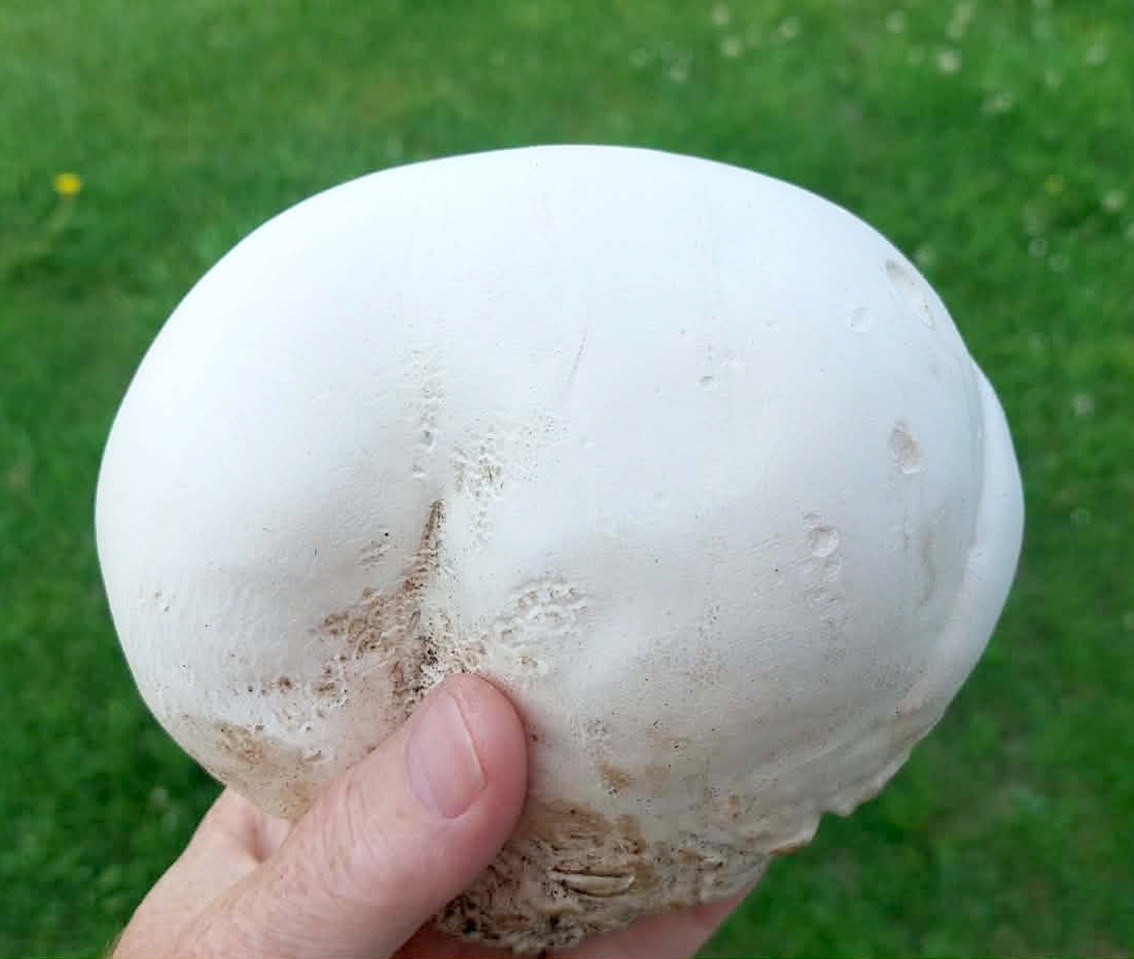
Photograph: Giant puffball, Calvatia gigantea, · Original source · Creative Commons license. Resized proportionally.
Puffballs are fungi whose spores develop inside a rounded fruiting body and are released as the body matures. The name covers several taxa, not one species. This sheet explains their biology and identification limits; it is not sufficient by itself to approve a wild mushroom for eating.
The ball is a reproductive structure
The larger organism is a network of hyphae in its substrate. After suitable conditions, it forms a fruiting body containing spore-producing tissue called the gleba. A young gleba can be firm and pale; with maturity it becomes a powdery mass of spores.
Different species release spores through an opening or through breakdown of the outer wall. Rain impact, wind, and disturbance assist dispersal. Avoid deliberately inhaling spore clouds or using mature puffballs as toys.
Several groups can look similar
Group or example | Useful feature | Limit |
|---|---|---|
Giant puffball, Calvatia gigantea | Can become much larger than a typical mushroom; young interior is uniformly white. | Size and color alone do not confirm identity. |
Smaller puffballs | Some have surface spines, ornamentation, or a distinct sterile base. | Species identification may require mature features and microscopy. |
Earthballs, Scleroderma species | Often have a tough outer wall and a darker interior as they develop. | They are not edible substitutes for puffballs. |
Immature gilled mushrooms | Some begin inside an enclosing veil. | A lengthwise section may reveal a developing cap, gills, or stem; deadly Amanita can be involved. |
A safety screen is not a complete identification
Cutting a specimen from top to bottom is an important examination step: developing gills, cap, or stem rule out a true puffball. A uniformly white interior is still not sufficient to establish species, safe condition, or suitability to eat. Young look-alikes and specimen variation require expert judgment.
Do not taste an unidentified specimen. Do not use a photograph, phone application, or this sheet as the sole identification method. Keep children and pets from eating unknown fungi. If ingestion occurs and poisoning is possible, contact Poison Control at 1-800-222-1222; call emergency services for severe symptoms.
Ecological role depends on the actual fungus
Many true puffballs decompose organic matter and return nutrients to the soil. They can occur in lawns, pastures, woodland edges, or decaying wood, depending on species. The presence of a fruiting body does not by itself show that a tree is diseased.
Record substrate, attachment, surface texture, internal structure, size, and whether fruiting bodies occur singly or in groups. Photograph before disturbing. A spore print or microscopic examination may be useful, but it does not make a novice identification automatically reliable.
Food use requires a separate confident identification
Some puffball species are edible when correctly identified, young, and in suitable condition. Other similar fungi are toxic or unsuitable. Contamination, deterioration, and individual reactions are additional concerns. Have the actual collection checked by a qualified local identifier before considering food use.
Sources and further reading
Missouri Department of Conservation Giant Puffball
North American Mycological Association mushroom poisoning resources
Additional photograph reference (not the image above): Hans Hillewaert, Giant puffball, CC BY-SA 4.0
