Soil chemistry controls the forms in which nutrients occur and how readily roots can obtain them. Nitrogen is especially mobile because microbes repeatedly convert it among organic matter, ammonium, nitrate, and gases. A fertilizer dose is therefore only the beginning of its fate.
Separate acidity nutrient storage and salinity
Property | Meaning | Practical limit |
|---|---|---|
pH | A measure of acidity related to hydrogen-ion activity. | It affects availability; it does not measure the quantity of fertilizer. |
Cation exchange capacity | Capacity to retain exchangeable positively charged ions. | It does not directly retain nitrate, which is negatively charged. |
Electrical conductivity | A measure of the solution’s combined ion conductivity. | High EC can signal salinity; it cannot identify which nutrient is excessive. |
Buffering | Resistance to pH change. | Equal pH values can require different amendment rates. |
Redox conditions | The electron-transfer environment associated with oxygen supply and biological activity. | Waterlogging changes chemical forms and microbial pathways. |
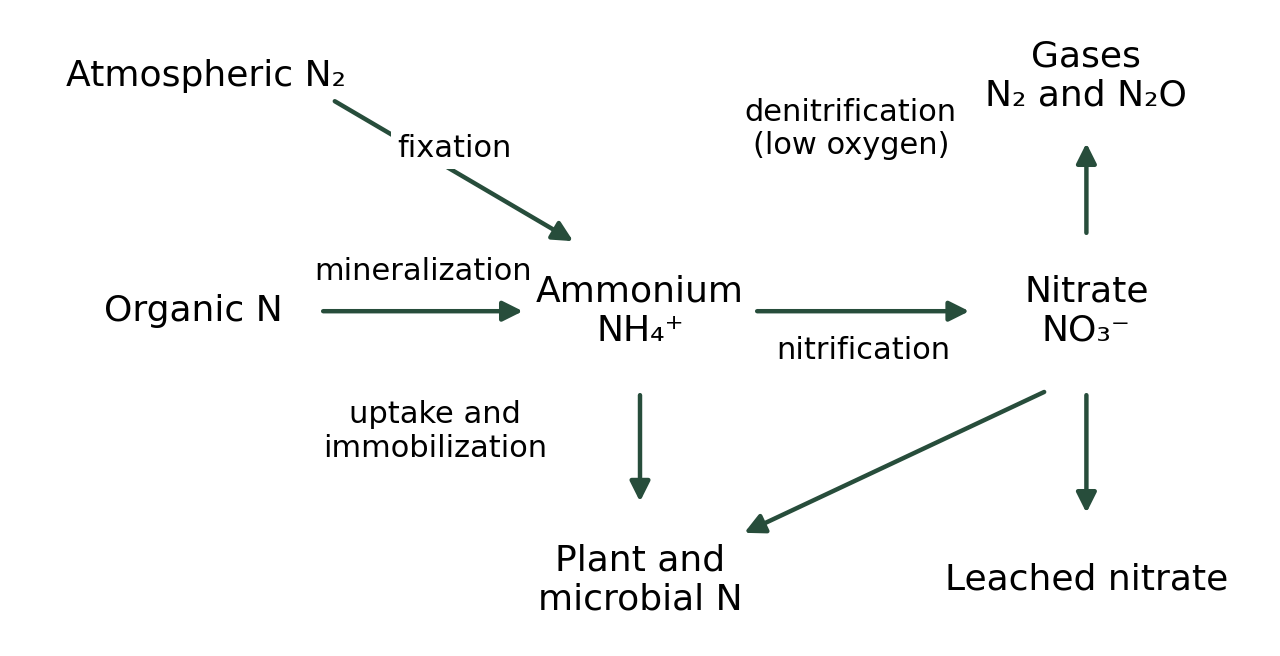
Nitrogen changes form through biological and chemical steps
Process | Conversion | Conditions and consequence |
|---|---|---|
Fixation | Atmospheric N₂ to biologically usable nitrogen | Specialized microorganisms perform the reduction; legumes rely on compatible symbionts. |
Mineralization | Organic nitrogen to NH₄⁺ | Decomposition releases ammonium; temperature and moisture affect the rate. |
Immobilization | Inorganic nitrogen to microbial organic nitrogen | Microbes can temporarily compete with roots, especially while decomposing carbon-rich residues. |
Nitrification | NH₄⁺ to NO₂⁻ to NO₃⁻ | Usually favored by oxygen; generates acidity and produces mobile nitrate. |
Denitrification | NO₃⁻ to gaseous nitrogen products | Low oxygen and available carbon favor losses as N₂ and sometimes N₂O. |
Volatilization | Ammoniacal nitrogen to NH₃ gas | Surface conditions, high pH, heat, and urea hydrolysis can increase loss. |
Leaching | Dissolved nitrogen moves below roots | Nitrate is especially vulnerable where drainage water carries it downward. |
Water oxygen and carbon govern the balance
Warm, moist, aerated soil can mineralize and nitrify nitrogen rapidly. Saturated soil restricts oxygen and may favor denitrification. Very dry or cold soil slows many processes. A sudden change in moisture can therefore change nutrient supply without any fertilizer application.
Plants commonly absorb both nitrate and ammonium, in proportions that vary by species and environment. Nitrate uptake is not proof that ammonium is useless. More nitrogen can increase growth only when some other resource or stress is not the controlling limit.
Use evidence before amending
Submit a representative sample to a laboratory using the appropriate soil or container-medium method. Specify the crop, site, and intended use. Follow the laboratory’s amendment recommendation rather than choosing a lime, sulfur, or fertilizer dose from pH alone.
Split nitrogen applications when appropriate for the crop and avoid applying before runoff-producing rain. Keep fertilizer out of drains and surface water. For a container, account for fertilizer already present in the starting mix and measure salts when symptoms suggest accumulation.
Yellow leaves can result from root damage, waterlogging, pH-related availability, disease, or insufficient light. A larger fertilizer dose can worsen several of those conditions.
Related Information Sheets
Soil Information Sheet - Soil Texture Triangle
Plant Health Information Sheet - Plant Disease Diagnosis
Sources and further reading
University of Minnesota Extension Understanding Nitrogen in Soils