

The soil texture triangle names the mineral fine-earth fraction from its percentages of sand, silt, and clay. Texture helps explain behavior, but it does not by itself tell whether a soil is fertile, well structured, or suitable as a container medium.
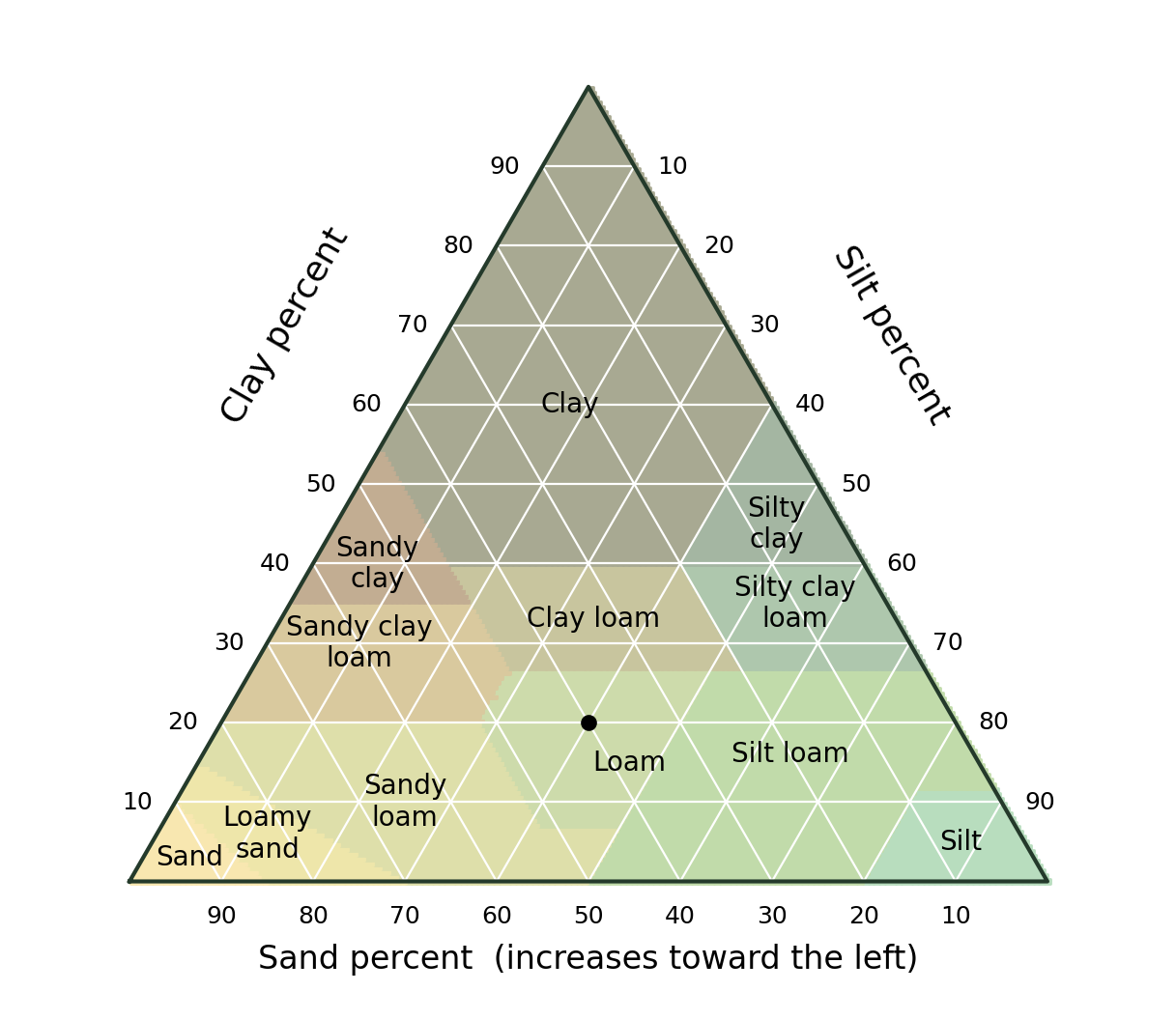
Three fractions must total one hundred percent
USDA fraction | Particle diameter | What to remember |
|---|---|---|
Sand | 0.05–2 mm | Gritty mineral particles; size is the definition. |
Silt | 0.002–0.05 mm | Intermediate size, commonly smooth when rubbed. |
Clay | Less than 0.002 mm | Very small particles; mineralogy affects swelling and nutrient retention. |
Coarse fragments | Larger than 2 mm | Reported separately; not included in the sand–silt–clay total. |
Read the axes rather than drawing vertical lines
Locate the clay percentage and follow its horizontal line. Follow the sand and silt grid directions parallel to their opposite sides. The three lines meet at one point. Read the name of the class containing that point. For a sample on a boundary, use the official calculator and the laboratory’s reporting convention.
Work through a complete example
A sample with 40 percent sand, 40 percent silt, and 20 percent clay totals 100 percent and plots as loam. A second sample with 20 percent sand, 20 percent silt, and 60 percent clay plots as clay. Loam does not mean equal thirds, and clay soil does not mean 100 percent clay particles.
When coarse fragments or organic matter are present, first establish the laboratory’s reporting basis. Do not mix whole-soil percentages with fine-earth percentages and expect the triangle to work.
Texture influences behavior through pores and surfaces
Coarse-textured soils often drain rapidly and hold less water per unit depth. Fine-textured soils often hold more total water, but not all of it is equally available to roots. Aggregation, organic matter, compaction, mineralogy, and biological channels modify these tendencies.
Texture is relatively stable unless mineral material is added or removed. Structure is the arrangement of particles into aggregates and pores; management can improve or damage it. Adding a small amount of sand to clay does not reliably create loam and can make the physical mixture worse.
Use an appropriate test
A hand-texture test gives a useful field estimate with practice. A jar settling test is only approximate: incomplete dispersion, organic matter, and uncertain timing distort layers. Hydrometer or pipette methods with proper sample preparation are stronger references.
Peat, coir, bark, perlite, and many commercial potting media are not ordinary mineral soil. The triangle is not a recipe for an airy container mix. For containers, assess water retention, air space, drainage, pH, and soluble salts directly.
Related Information Sheets
Soil Information Sheet - Soil Chemistry and Nitrogen Conversions
Botany Information Sheet - Vegetable Root Systems