

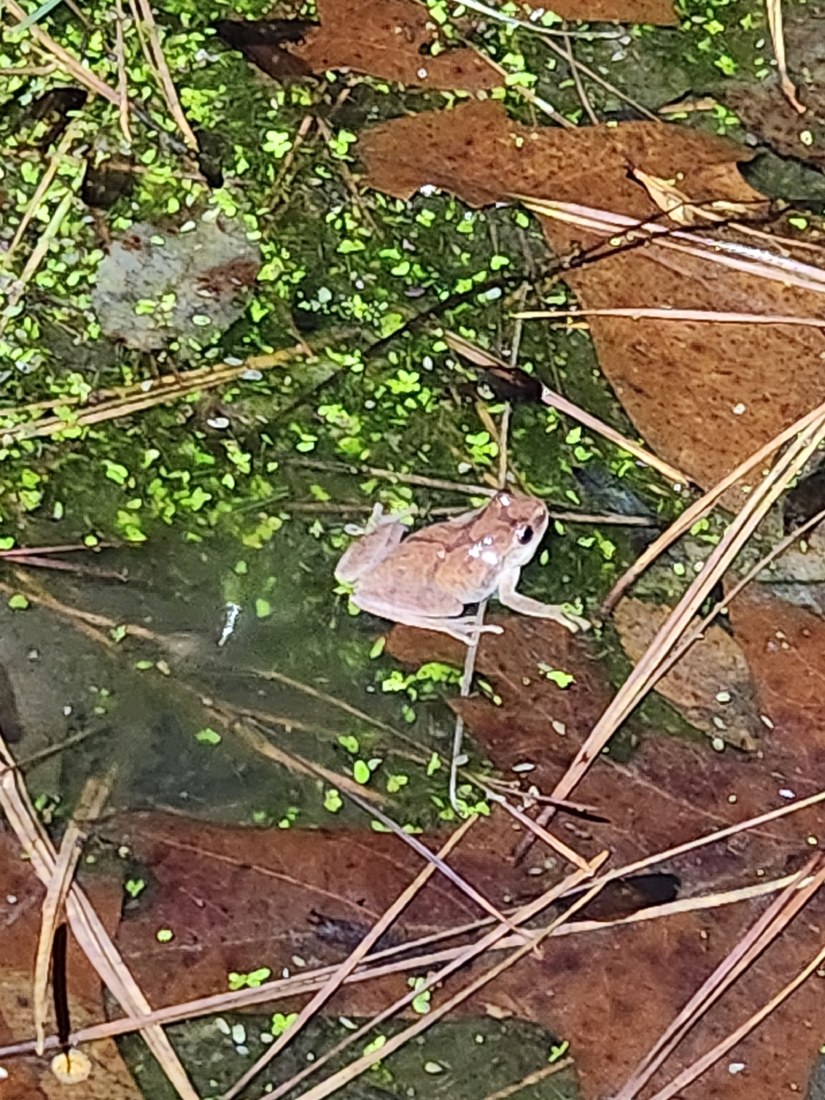
Photograph: Jeremy Chamberlain · Original source · Creative Commons license. Resized proportionally.
The spring peeper, Pseudacris crucifer, is a small eastern North American frog best detected by its high-pitched spring call. Its life depends on both breeding wetlands and the surrounding terrestrial habitat. This sheet is for field observation and habitat understanding, not a captive-care prescription.
Identify the frog with several clues
Adults are commonly about 0.75–1.25 inches (19–32 mm) from snout to vent. A dark, sometimes faint X on the back gives the species its name. Color ranges through tan, brown, gray, and pinkish tones. Small toe pads aid climbing.
The male’s repeated clear peep can produce a loud chorus. Call quality, season, location, and body pattern together help distinguish peepers from other chorus frogs. Temperature changes call timing, so a quiet site does not prove absence.
Wetlands and nearby cover are one habitat system
Peepers breed in shallow wet places, often temporary or fishless pools near woodland. Adults spend substantial time in adjacent vegetation and leaf litter. Protecting a breeding pool while clearing or isolating all nearby cover can still damage the population.
The species is part of Indiana’s fauna, but this sheet does not establish a verified occurrence at a particular Lafayette property. A site record needs observation, a reliable local record, or a documented survey.
Life stages use different resources
Stage | Setting and resource use | Useful observation |
|---|---|---|
Egg | Laid in water, associated with submerged material. | Look without disturbing vegetation or moving eggs. |
Tadpole | Aquatic; grazes and consumes small organic resources. | Record water persistence and whether fish are present. |
Metamorph | Transitions to land as limbs develop and the tail is absorbed. | Protect damp shoreline cover and movement routes. |
Adult | Consumes small terrestrial invertebrates. | Listen and photograph from a distance; note weather and habitat. |
Seasonal timing responds to weather
Breeding commonly occurs in early spring, with local timing governed by temperature and rainfall. Eggs develop into tadpoles and then froglets over a period that varies with conditions. Adults overwinter in protected terrestrial sites; cold tolerance involves physiological adaptations, not an ability to survive every freeze exposure.
No single household temperature or humidity setting represents all stages of this wild frog’s life. Preserve natural hydrology, shade, vegetation, and overwintering cover rather than applying a generic terrarium recipe.
Observe without moving animals or spreading disease
Avoid unnecessary handling. Amphibian skin is sensitive, and equipment can transfer pathogens between wetlands. Follow current agency guidance for cleaning field gear. Do not move frogs, eggs, water, or plants between sites.
Threats include wetland drainage, road mortality during movement, contaminants, and loss of surrounding cover. Maintain habitat connections and avoid pesticide runoff. Before any collection or captive keeping, check current Indiana rules and obtain species-specific care guidance.
Sources and further reading
Missouri Department of Conservation Spring Peeper
Indiana DNR Nongame and Endangered Wildlife
Additional photograph reference (not the image above): JimmyButler, Spring peeper, CC BY-SA 3.0
