Stomata are adjustable pores that connect a plant’s internal air spaces with the atmosphere. They help balance carbon dioxide supply against water loss. Their behavior explains why a plant can have plenty of sunlight yet slow its photosynthesis during drought.
At a glance
Term | Meaning |
|---|---|
Stoma and stomata | Stoma is singular; stomata is plural. |
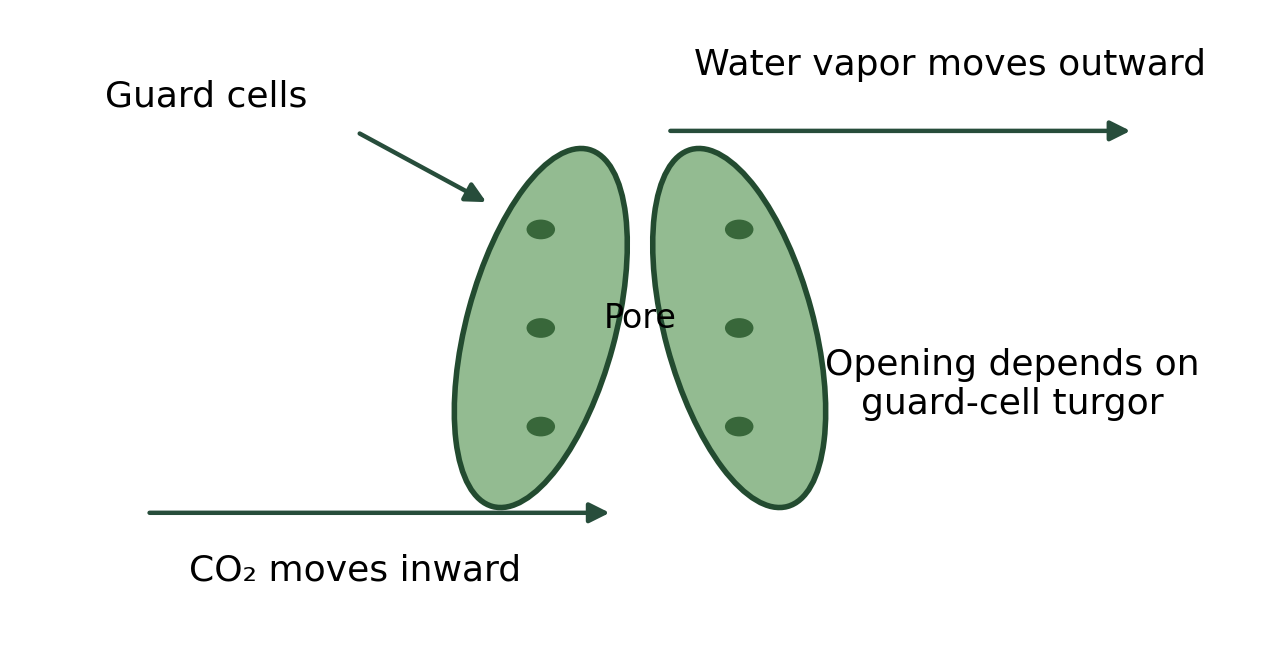
Guard cells | The paired cells that change the width of the pore. |
Stomatal conductance | How readily gas passes through the stomata; it changes with pore opening and stomatal density. |
Transpiration | Water vapor loss, much of it through stomata. |
Guard cells control an opening
Most familiar leaves have many stomata in the epidermis, often concentrated on the lower surface. Distribution varies: floating leaves commonly have them on the upper surface, while fully submerged leaves often lack functional stomata. Stomata also occur on some green stems.
The pore opens into an internal air space. Carbon dioxide diffuses toward photosynthetic cells when its concentration is lower inside. Water vapor diffuses outward when the surrounding air is drier than the air spaces. These are diffusion processes, not pumps that push air through a leaf.
Water and ion movements change the pore
Guard cells accumulate solutes, including potassium ions and organic solutes. Water enters osmotically, raising turgor pressure; the cells’ wall structure makes the pore widen. Solute release and water loss reduce turgor and favor closure. The details differ between kidney-shaped guard cells and the dumbbell-shaped complexes of grasses.
Light, internal carbon dioxide, humidity, temperature, plant water status, and chemical signals interact. During water stress, abscisic acid helps trigger closure. Closing saves water but restricts carbon dioxide entry; prolonged closure therefore limits carbon gain.
Different plants use different schedules
Many plants open stomata mainly by day. CAM plants shift much of their carbon dioxide uptake to night and store carbon in organic acids for daytime use. This reduces water loss in dry habitats. CAM behavior varies with species and conditions; it is not a rule that every succulent always opens only at night.
High vapor pressure deficit increases the drying demand of the air. Hot, dry conditions may cause closure even when the soil is not completely dry. A wilted leaf therefore does not establish a fertilizer deficiency.
Observe a leaf without confusing structure with function
A microscope can reveal guard cells in a suitable epidermal peel or leaf impression. Record species, leaf surface, magnification, and scale. Count pores over a known area to estimate density. Density alone does not tell how wide pores were open or how much water the plant lost.
For plant care, combine light, temperature, air movement, and root-zone moisture observations. More humidity may reduce drying demand, but stagnant wet conditions can encourage disease. Improve the whole growing environment rather than treating stomata as a switch that can be forced independently.
Related Information Sheets
Plant Care Information Sheet - Choosing Plants for Indoor Conditions
Sources and further reading
OpenStax Biology 2e section 30.4 Leaves
OpenStax Biology 2e section 30.5 Transport of Water and Solutes in Plants
OpenStax Biology 2e section 8.3 Using Light Energy to Make Organic Molecules