Mosses are small land plants that reproduce by spores and absorb much of their water across exposed surfaces. Their life cycle and moisture relations differ from those of flowering houseplants. This sheet covers mosses generally; individual species still require identification for precise habitat or cultivation advice.
Recognize a moss as a plant
The familiar green mat or tuft is usually the haploid gametophyte. It has small leaf-like structures on shoots and anchoring rhizoids rather than true roots. Mosses lack the true vascular system of ferns and seed plants, although some have specialized conducting cells.
Moss is not mold, a lichen, or algae. Spanish moss is a flowering bromeliad, and clubmosses are vascular plants. Common names can therefore obscure major biological differences.
Two generations share one life cycle
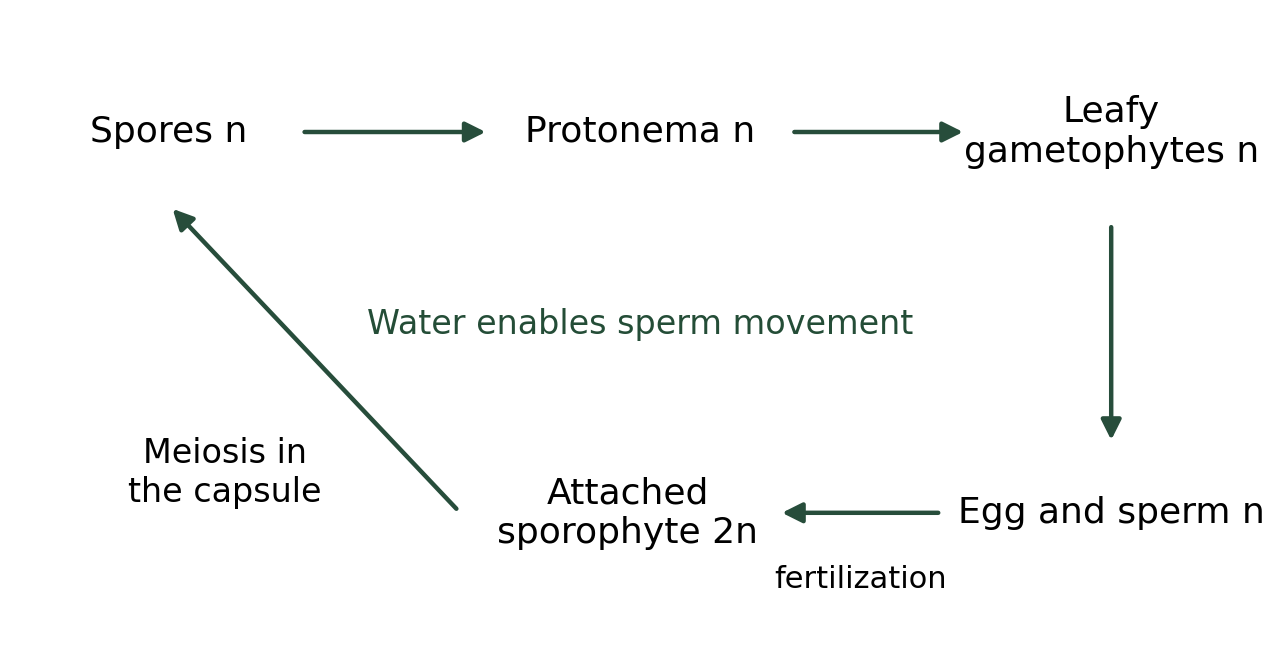
A spore germinates into a protonema, from which leafy shoots develop. Gametophytes produce eggs and sperm. Sperm generally need a film of water to reach an egg. Fertilization produces a diploid sporophyte that remains attached to and nutritionally dependent on the gametophyte.
Meiosis inside the sporophyte capsule produces haploid spores. Wind or other movement disperses them. Fragmentation and specialized vegetative structures also allow many mosses to spread without completing the sexual cycle.
Moisture adaptation varies among species
Many mosses tolerate drying and resume activity after rewetting, but the degree of tolerance varies. A species from a shaded stream bank may fail on a hot exposed stone. Some mosses prefer acidic substrates, while others favor calcareous rock or different bark chemistry.
Sphagnum has unusual water-holding cells and helps build peat-forming environments. It should not be treated as a model for every moss. Peatlands store large amounts of carbon, and their hydrology matters to the whole ecosystem.
Read the site before changing it
Moss on a lawn can indicate conditions unfavorable to turf, including shade, compaction, persistent moisture, or thin grass cover. It does not by itself diagnose low pH. Test soil and assess drainage and light before adding lime or fertilizer.
A moss garden needs a species–site match, stable moisture appropriate to that species, and limited smothering by leaves or debris. Rich potting mix and heavy feeding are not universal requirements. Avoid collecting from protected land or removing slow-growing natural mats.
Observe with a hand lens and a record
Record substrate, sun exposure, moisture, growth form, leaf arrangement, and the presence of capsules. Photograph both the whole patch and a close-up with scale. Species identification often requires microscopic leaf and cell characters; a distant green patch is not enough.
For an experiment, compare growth under measured moisture and light while holding substrate and starting material consistent. Distinguish a change in hydration from actual new biomass.
Related Information Sheets
Biology Information Sheet - Algae Lichens and Mosses
Botany Information Sheet - Plant Evolution Timeline
Sources and further reading
OpenStax Biology 2e section 25.3 Bryophytes
Australian National Botanic Gardens Introduction to Bryophytes